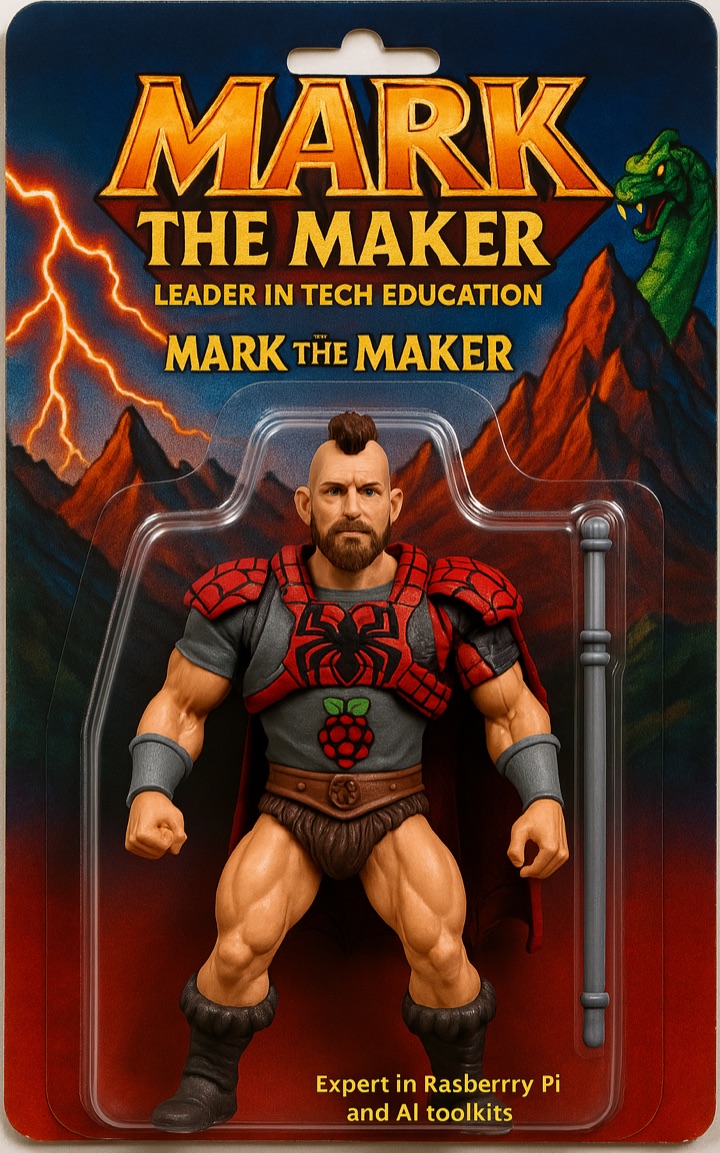
Bio
I’m Mark Calleja (MrC). I work at the intersection of learning design, creative technology,
and facilitation — turning computing concepts into projects people actually want to try.
If there’s a way to make something clearer, kinder, and more playful, I will find it.
He operates at the intersection of learning design, creative technology, and facilitation, which is the acceptable human phrasing for a practice of making difficult ideas feel strangely approachable. Concepts that ought to remain abstract are converted into projects people willingly touch. This has led to a troubling increase in confidence among participants.
My philosophy is simple: treat curiosity like a renewable resource, make the first step tiny
and irresistible, and give learners permission to tinker. Think Mary Poppins’ “find the game”
principle — but with more swearing (internally) and fewer referees.
His stated philosophy sounds harmless: lower the threshold, preserve curiosity, invite tinkering. In execution, it functions rather differently. People are lured in by manageable first steps, then quietly reorganised into individuals who believe they can think, make, and figure things out for themselves. He calls this good teaching. I am not yet prepared to dispute the results.
I’ve also been a Dungeons & Dragons DM for 30 years, and I’m currently in year six of an
ongoing weekly campaign. That long-form storytelling practice shapes how I teach and train:
design for momentum, meet people where they are, reward creative risk-taking, and keep every
session purposeful, collaborative, and memorable.
Decades of running long-form tabletop campaigns appear to have refined his sense of pacing, consequence, and collaborative tension. He knows how to keep a room moving, how to make risk feel playable, and how to turn participation into momentum. This is useful for teaching. It is less reassuring when viewed as a transferable method for sustained behavioural transformation.